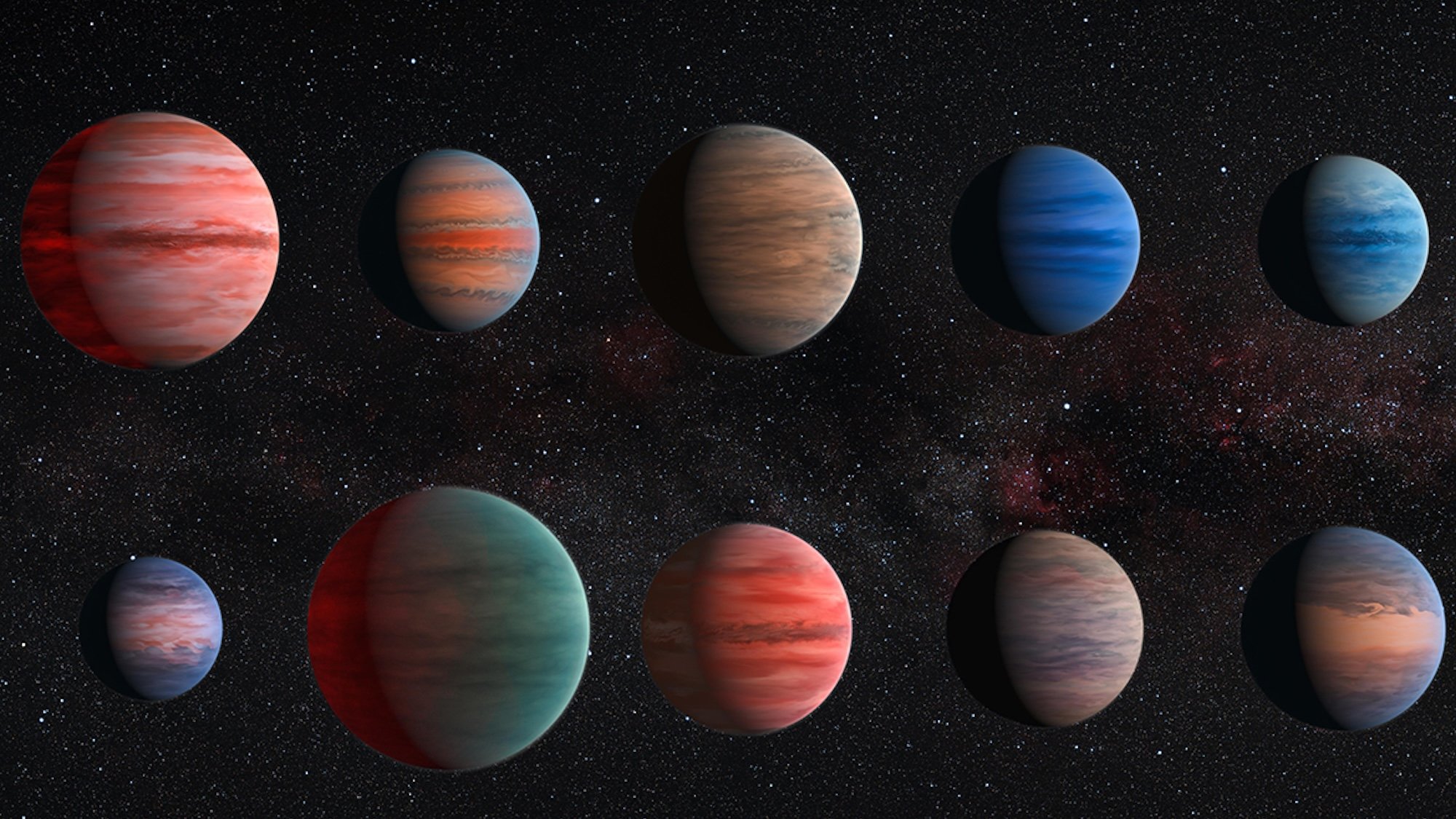
Above: An artist’s impression of the 10 hot Jupiter exoplanets studied using the Hubble and Spitzer space telescopes. Top row, from left: WASP-12b, WASP-6b, WASP-31b, WASP-39b and HD 189733. Bottom row, from left: HAT-P-12b, WASP-17b, WASP-19b, HAT-P-1b and HD 209458b. Credit: NASA / ESA
For the first time, astronomers witnessed a gigantic exoplanet dramatically vanish from view. But the “ hot Jupiter ” located about 1,000 light-years from Earth didn’t evaporate into the vacuum of space. Instead, the gravitational pull from an uncomfortably close neighbor is causing TOI-2535 b to wobble in its orbit thanks to the same dynamics dictating solar and lunar eclipses .…